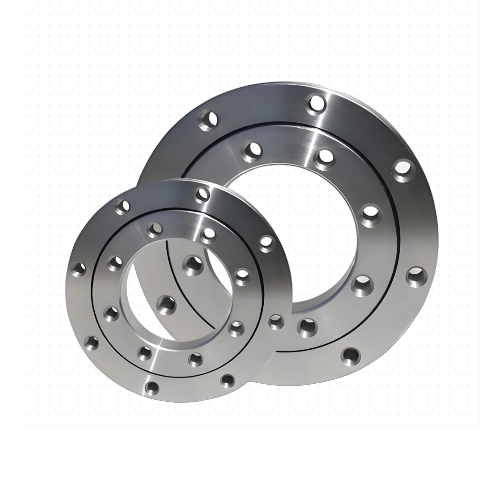
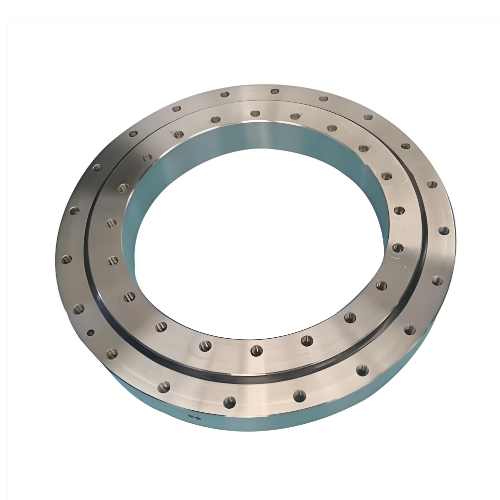
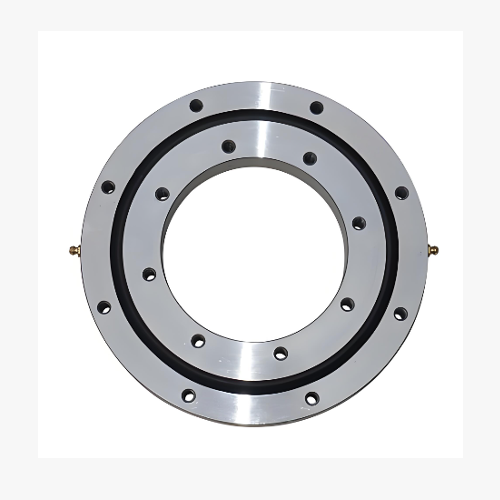

As a leading rotary bearing manufacturer, we offer high-performance Small-Sized Toothless Slewing Ring Bearings designed for applications demanding precision and a lightweight footprint.
Key Features:
Compact Design: Optimized for limited installation spaces without compromising load capacity.
Toothless Configuration: Features a smooth inner and outer ring, providing flexibility for external drive systems or free-running applications.
Smooth Rotation: Precision-ground raceways ensure minimal friction and excellent rotational accuracy.
Versatile Mounting: Pre-drilled mounting holes allow for quick and secure installation.
Applications:
These bearings are widely used in automation equipment, medical scanners, small-scale turntables, radar antennas, and optical positioning systems. They provide the reliability and durability required for 24/7 operational cycles. Contact us to customize your bearing solution today.
1. What is a "small slewing ring" typically used for?
Small slewing bearings (without gear teeth) are commonly used in robotics, manipulators, jib cranes, lift-assist devices, and medical equipment. They are ideal for applications requiring compact dimensions, light weight, and precise rotation.
2. What are the advantages of a gearless (without teeth) design?
Choosing a bearing without gear teeth offers greater flexibility. It allows you to design your own custom drive system (such as an external gear, belt drive, or friction drive) independent of the bearing. They are often more compact and cost-effective for applications where the drive mechanism is already determined.
3. What types of loads can these bearings support?
Despite their small size, they are designed to handle combined loads. Depending on the type (e.g., four-point contact ball or crossed roller), they can simultaneously support axial loads, radial loads, and tilting moments.
4. How do I install a small gearless slewing bearing?
Installation is straightforward. The bearing rings feature mounting holes (through or threaded) for direct bolting to adjacent structures. It is critical that the mounting surfaces are flat and clean, and bolts must be tightened to the specified torque in a diagonal sequence to prevent distortion.